Child poverty forecasts
The Treasury forecasts future levels of child poverty on the AHC50 and BHC50 measures, based on economic forecasts and changes in key income-support measures. This modelling involves considerable uncertainty, so future child poverty rates are expressed as a range. The Treasury's model is unable to forecast material hardship.
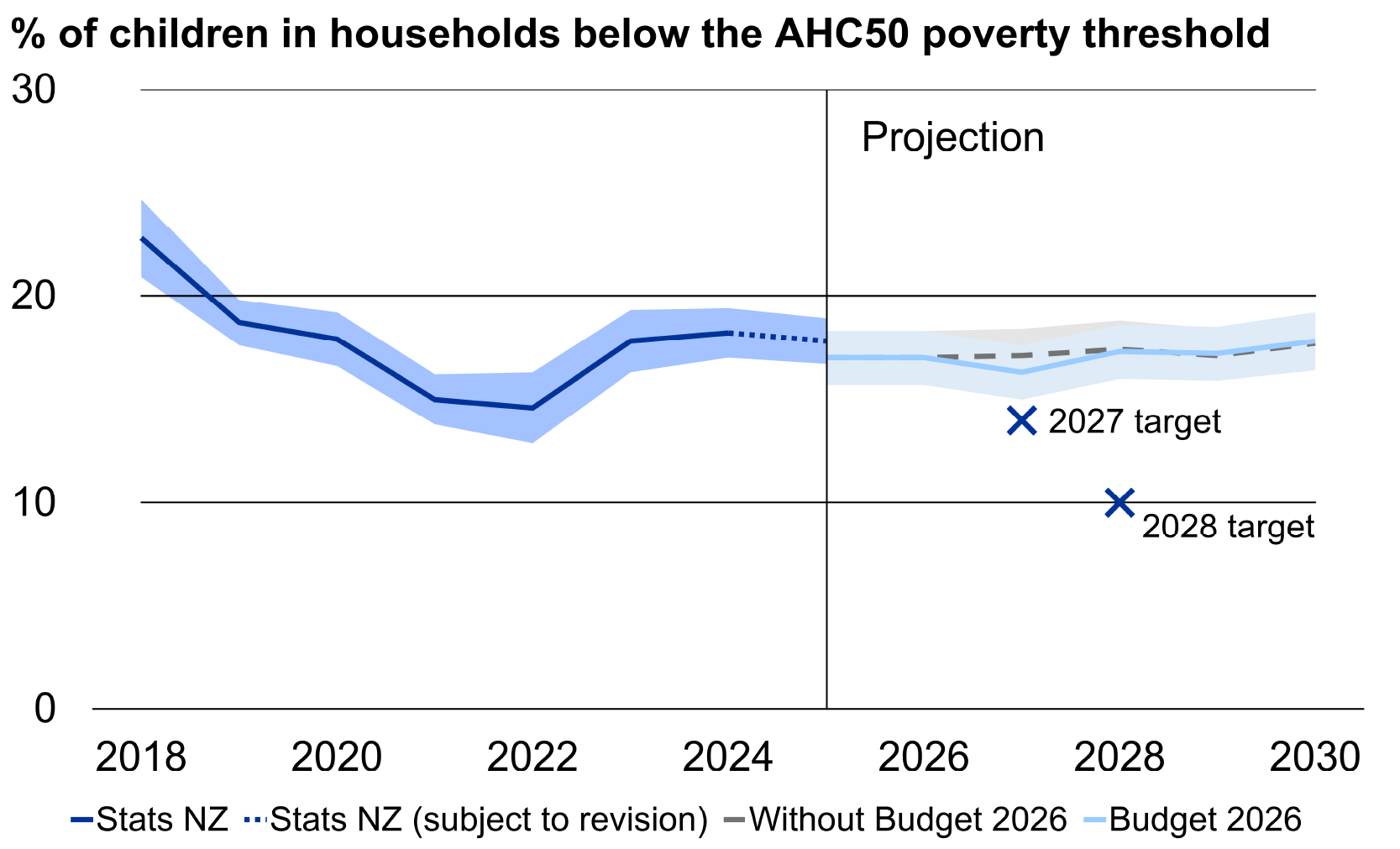
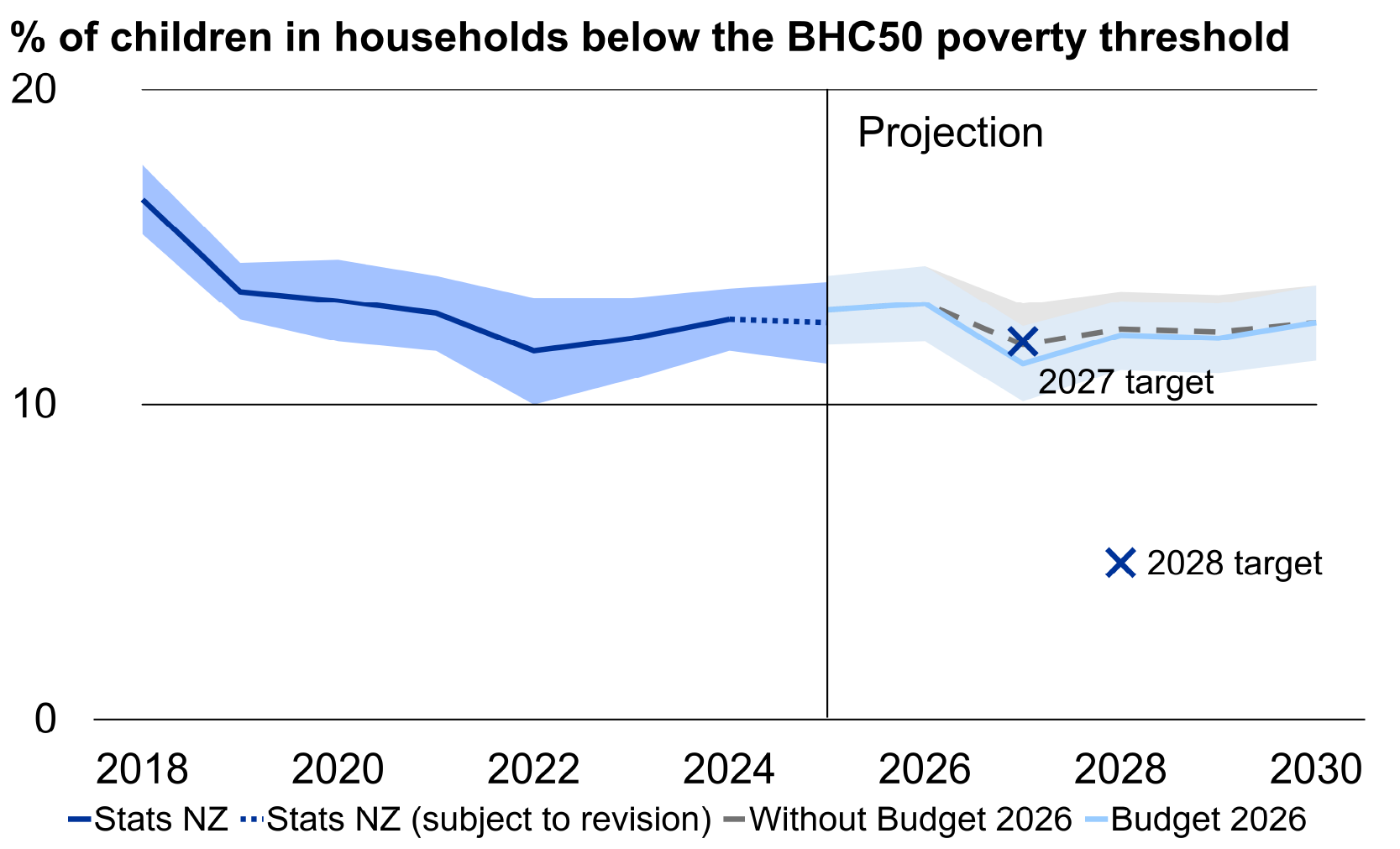
The latest forecasts and historical figures are shown below. Shaded areas around the lines show the 95 per cent confidence intervals. Tax and transfer measures in the Budget 2026 package are estimated to decrease child poverty in 2026/27, on both the AHC50 and BHC50 measures. These decreases are statistically significant and are driven by the temporary, $50 a week increase in the in-work tax credit. Impacts in subsequent years are small and not statistically significant.
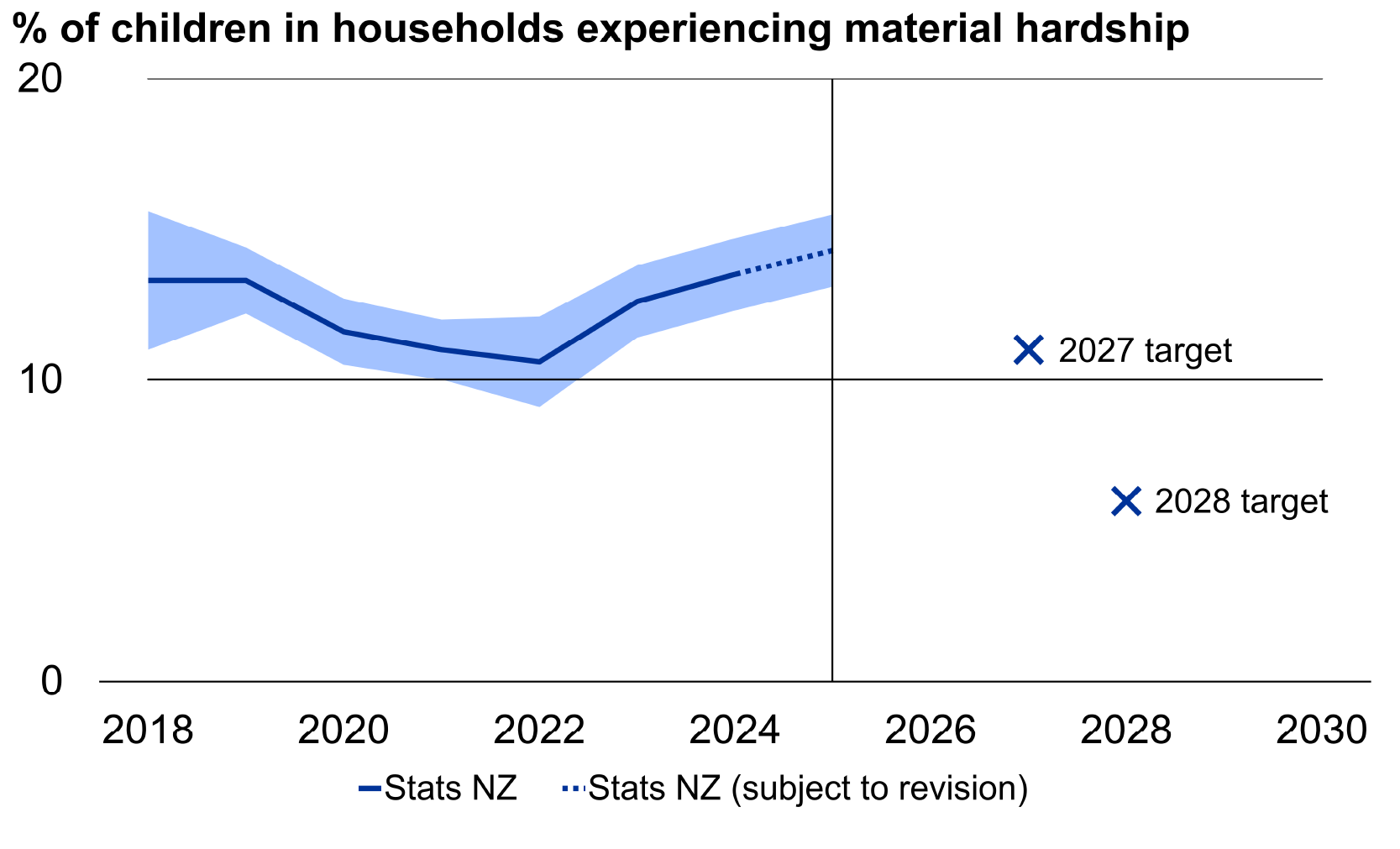
Material hardship
How many households do not have access to the essential items for living?
The Treasury's model cannot estimate material hardship.
After-housing-costs, fixed-line measure (AHC50)[4]
How many households have very low incomes relative to previous years, after considering housing costs and increases to the cost of living?
| 2030 | |
|---|---|
| Projection | 17.8 per cent |
| Margin of error | ± 1.4 (percentage points) |
Before-housing-costs, moving-line measure (BHC50)
How many households have much lower incomes than middle-income households?
| 2030 | |
|---|---|
| Projection | 12.6 per cent |
| Margin of error | ± 1.2 (percentage points) |
Note
- [4] There is a discontinuity between Treasury modelling and Stats NZ's most recently reported child poverty statistics for 2025, because the 2025 statistics are subject to revision as updated Working for Families data become available over the next year, in line with standard practice.