Fiscal strategy
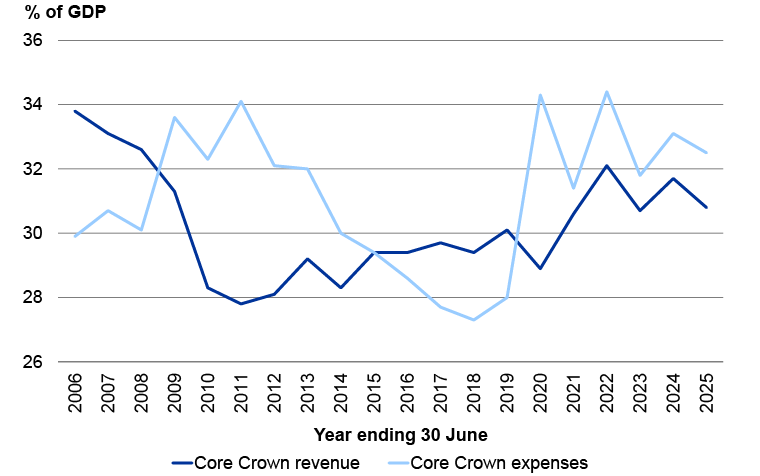
New Zealand is in a challenging fiscal position. The Crown's books have deteriorated since 2019 as expenses have risen faster than revenue (Figure 1). The increase in expenses as a percentage of GDP is due to a combination of factors: discretionary policy decisions, the temporary impact of the COVID-19 pandemic and weather events, the economic downturn, cost increases above those in the rest of the economy, demographic changes and higher borrowing costs. Table 1 sets out the contribution of different spending areas to the increase in core Crown expenses since 2018/19.
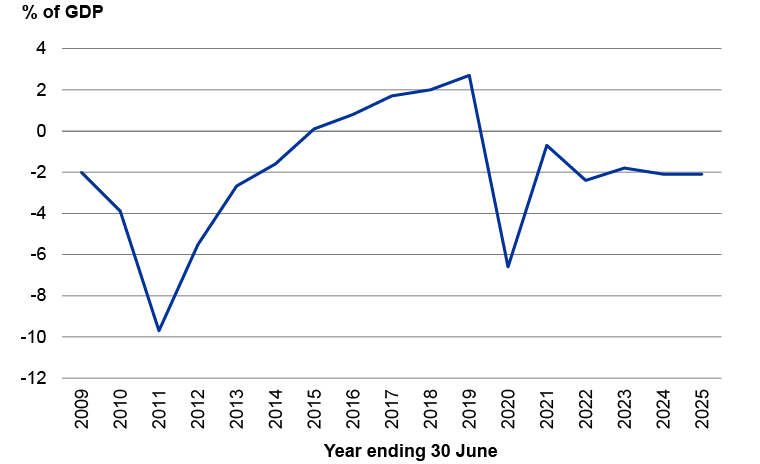
The Government's headline operating balance indicator is the total Crown operating balance before gains and losses, excluding ACC (OBEGALx). Rising expenses mean OBEGALx has been in deficit since 2019/20 (Figure 2). Persistent deficits, together with capital spending, have in turn led to a sharp increase in net core Crown debt from below 20 per cent of GDP in 2018/19 to 41.8 per cent in 2024/25 (Figure 3).
Figure 1 - Core Crown revenue and expenses
Source: The Treasury
Figure 2 - OBEGALx
Source: The Treasury
Figure 3 - Net core Crown debt
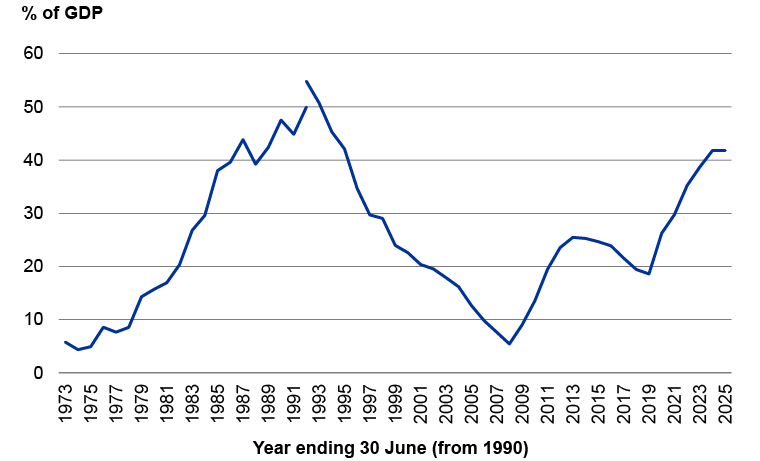
* The measure of net core Crown debt adopted in 2009 is restated back to 1992. The earlier measure for the period before 1992 included advances. March years are used prior to 1990.
Source: The Treasury
Table 1 - Increase in core Crown expenses from 2018/19 to 2024/25 by functional classification
| Functional classification | % of GDP | $billions |
|---|---|---|
| Core Crown expenses 2018/19 | 28.0 | 87.0 |
| New Zealand Superannuation | 0.6 | 8.6 |
| Welfare benefits | 0.7 | 8.1 |
| Health | 1.1 | 12.0 |
| Finance costs | 0.8 | 5.2 |
| Transport | 0.3 | 2.6 |
| Housing | 0.3 | 1.4 |
| Education | 0.2 | 6.6 |
| Other | 0.5 | 10.2 |
| Core Crown expenses 2024/25 | 32.5 | 141.7 |
Source: The Treasury
The operating deficit is structural so will not resolve itself as the economy recovers. Fiscal consolidation is required to bring revenue and expenses back into balance and start reducing debt. The Government’s fiscal strategy, as set out most recently in the 2025 Fiscal Strategy Report (FSR), is to achieve this consolidation over time, and specifically to:
- reduce core Crown expenses towards 30 per cent of GDP
- return the headline operating balance measure to surplus, and
- put net core Crown debt as a percentage of GDP on a downward trajectory towards 40 per cent and in the longer term keep it below that percentage.
Spending restraint over the medium term is the key to realising this strategy. Taking a deliberate medium-term approach to fiscal consolidation means the Government will not over-react to inevitable changes in fiscal forecasts. Downward revenue surprises will not necessitate a sharp spending reduction. Upside revenue surprises will contribute to reducing the deficit.