Managing assets and liabilities
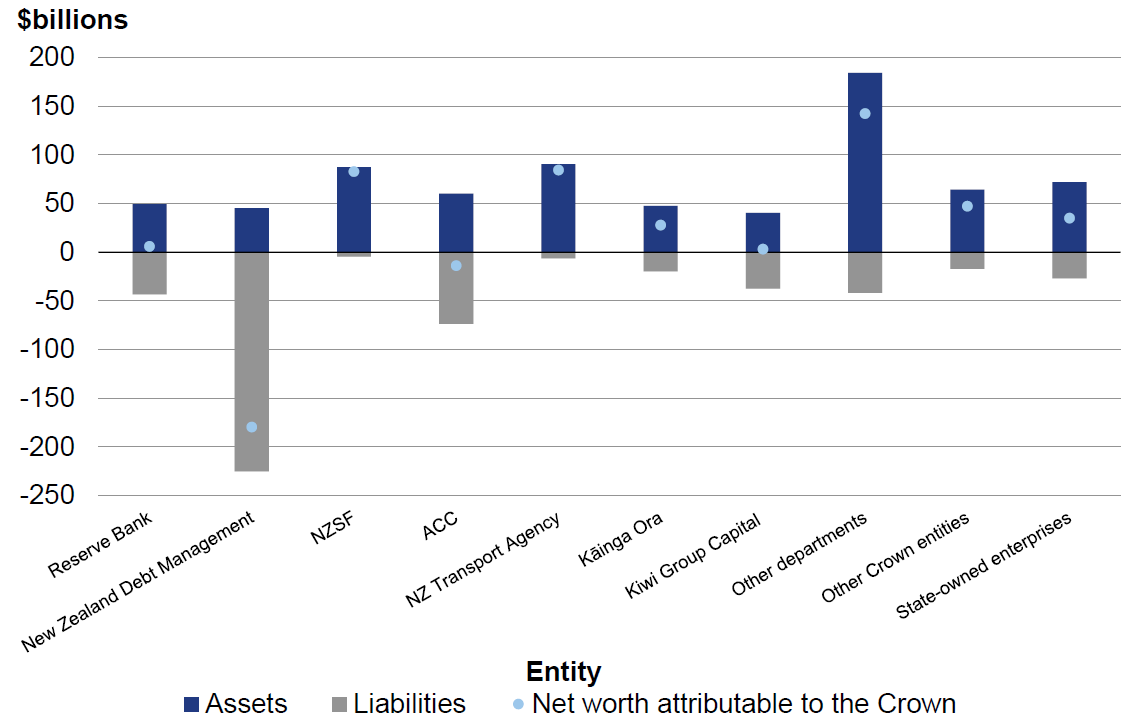
The Crown's balance sheet records what it owns — its assets — and what it owes — its liabilities (Figure 14). The Crown's assets include physical infrastructure (such as hospitals, schools and roads), financial assets (such as the NZSF) and commercial entities. Its liabilities consist mostly of debt issued by the Crown.
Figure 14 — Net worth attributable to the Crown for 2024/25 by entity
Source: The Treasury
Note: This chart displays unconsolidated net worth attributable to the Crown. It does not sum to the overall net worth attributable to the Crown because inter-entity balances are eliminated in the consolidated accounts (e.g. ACC's holdings of government bonds).
The 2024/25 year-end financial statements show the Crown owns $598 billion of assets and has $409 billion of liabilities. The difference between these two numbers, excluding $10 billion attributable to minority interests, is net worth attributable to the Crown of $179 billion, or around 41 per cent of GDP. Forecasts of net worth attributable to the Crown have improved since HYEFU, in part due to the adoption of a new accounting standard that has decreased the Crown's insurance liabilities.
The Government's strategy for managing the Crown's assets and liabilities is to ensure a robust decision-making framework for new investments, increase the effectiveness of existing assets through more targeted maintenance and manage risks that can reduce asset values or create unexpected liabilities.
Earlier this year, the Infrastructure Commission released the National Infrastructure Plan, which sets out a 30-year view of how New Zealand can improve the way it plans, funds, maintains and delivers infrastructure. The plan makes 16 recommendations to improve the infrastructure system and identifies 10 priority actions for the next decade, many of which reflect work already underway by the Government.
New Zealand Government Bonds (NZGBs) are the government's primary funding instrument and the largest source of liabilities on the Crown's balance sheet. Box 5 sets out how these liabilities are managed through the borrowing programme.
Box 5 — New Zealand borrowing programme
New Zealand Debt Management (NZDM), a unit within the Treasury, is responsible for funding the Crown’s borrowing requirements. Its primary objective is to minimise the Crown’s borrowing costs over the long term while managing risk. To achieve this, NZDM considers the optimal volume of issuance for each instrument, the desired maturity profile of new and existing debt, investor demand and prevailing market conditions. By taking this approach, NZDM aims to capture and stimulate investor demand, reduce uncertainty associated with funding activities, and promote a well-functioning and liquid market for New Zealand government debt.
NZDM raises funds by selling New Zealand Government Securities, which include NZGBs, Treasury Bills and Euro-Commercial Paper. NZGBs are the primary instrument for Crown borrowing and are sold in two ways:
- Tenders, which are online auctions. These are usually held weekly, with NZDM recently offering $400 million to $500 million each tender.
- Syndications, where a group of financial intermediaries is appointed to sell a large volume of bonds in a single transaction. In recent years, NZDM has executed three to five syndications annually, for between $3 billion and $6 billion at each transaction.
New Zealand's sovereign credit rating remains among the highest globally. This is one of the factors that make NZGBs attractive to a wide range of investors, including fund managers, banks, insurance companies, hedge funds and central banks. Around 60 per cent of NZGBs are held by offshore investors, with the rest held by domestic investors.