Operating allowances
There are two possible levers to achieve fiscal consolidation: managing expenditure and raising revenue. The Government's strategy for managing expenditure is to embed a culture of responsible spending, restore fiscal discipline, right-size the government's footprint and improve the efficiency and productivity of spending. With prudent control of spending, the Government does not intend to seek major additional sources of revenue, although will maintain an active tax policy programme to ensure the tax system remains fit for purpose (see revenue strategy below).
Budget operating allowances are the key to realising this strategy. The operating allowance is the maximum amount of net new operating funding — on average, per annum — the Government intends to spend in the forthcoming Budget. The operating allowance captures spending and revenue decisions that are under the Government's direct control. It does not include most forecast changes, or automatic adjustments to benefits and NZ Superannuation, which are managed outside the allowance framework.
Operating allowances are a net concept. Spending increases, savings and any revenue decisions offset each other within a single envelope.
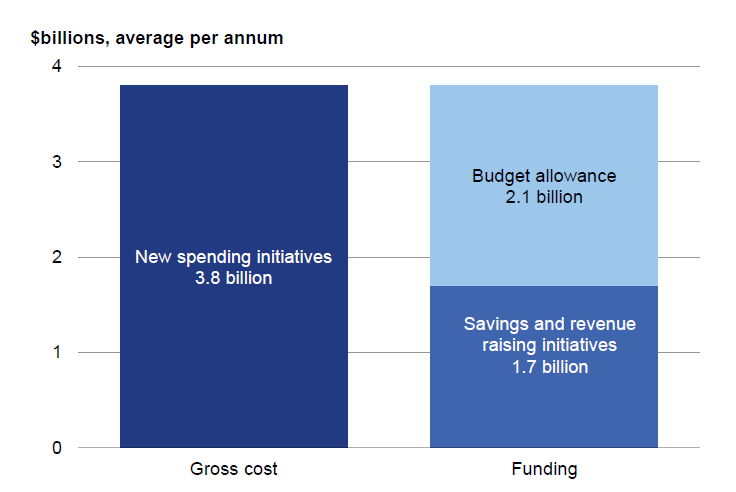
The operating allowance for Budget 2026 was $2.4 billion. The actual net Budget 2026 operating package comes to $2.1 billion. This net operating package is made up of $3.8 billion of new spending less $1.7 billion of savings and revenue, continuing the Government's drive over successive Budgets to find savings and reprioritise spending (Figure 12).
Figure 12 — Funding of the Budget 2026 operating package
Source: The Treasury
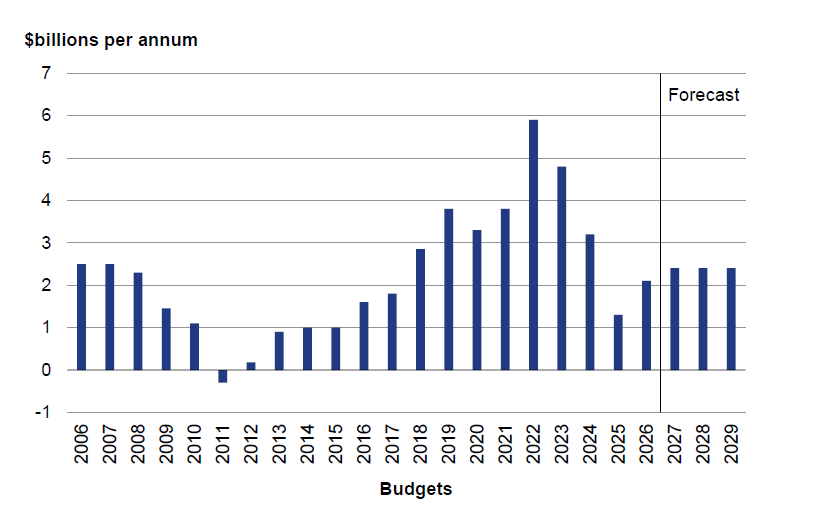
Figure 13 — Operating allowances
Source: The Treasury
The operating allowances for Budgets 2027, 2028 and 2029 remain at $2.4 billion. These are tight allowances, particularly compared to those for Budgets 2018 to 2023 (Figure 13).
Box 3 — Public service transformation
The Government is embarking on a fundamental overhaul of the public service to improve services, lift productivity and deliver better value for money. Between 2017 and 2023, the size of the public service expanded from approximately 47,000 people to more than 65,000 — almost three times as fast as the overall labour force — and back-office and support functions grew significantly faster than frontline service delivery roles. In its reforms, the Government will drive progress on three key goals: streamlining the number of government agencies and entities, digitising customer-facing and back-office government functions and restoring public service numbers to historic norms.
Budget 2026 includes an initial savings exercise where most agencies are delivering savings of 2 per cent, from 2026/27 onwards, on eligible baselines. Following this, the more fundamental overhaul is being implemented by putting a sinking lid on agencies’ operating budgets. From 2027/28, an additional baseline reduction of 5 per cent for most agencies is planned, followed by another 5 per cent reduction from 2028/29. Agencies excluded from the baseline savings exercise include law and order agencies, Oranga Tamariki, health, education (excluding tertiary), defence and intelligence agencies. All these savings are being counted in the Budget 2026 operating package.